
Pediatric Physiotherapy for Coordination Issues
A child may understand exactly what they want their body to do, yet still struggle to keep up on the playground, catch a ball, ride a bike, or manage stairs without holding the rail. Pediatric physiotherapy for coordination issues can help children develop the movement skills, strength, balance, and confidence needed for everyday activities without making them feel as though they are failing at something that should be easy.
Coordination challenges are not always obvious in a brief interaction. Some children compensate well at school or avoid activities that feel difficult. Others may appear clumsy, slow, distracted, or reluctant to join sports. A thoughtful physiotherapy assessment looks beyond the label and considers how a child moves, plays, learns new skills, and participates in daily life.
What Coordination Issues Can Look Like in Children
Coordination is the ability to plan, organize, and control movement. It depends on many systems working together, including muscle strength, balance, body awareness, vision, sensation, and timing. When one or more of these areas is challenging, routine tasks can require much more effort.
A child with coordination difficulties may frequently trip or bump into objects, have trouble hopping on one foot, struggle to throw or catch a ball, or find it hard to learn playground games. They may take longer to dress, avoid bicycles or scooters, tire quickly during active play, or become frustrated when movements do not work the way they expect.
These concerns do not automatically mean a child has a medical condition. Children develop at different rates, and some need more time and practice with certain skills. However, when challenges are persistent, affect confidence, limit participation, or seem greater than expected for a child’s age, an assessment can provide useful direction.
How Pediatric Physiotherapy for Coordination Issues Helps
The goal of care is not to make every child move in exactly the same way. It is to help them function more comfortably, safely, and confidently in the activities that matter to them and their family.
A pediatric physiotherapist begins by learning about the child’s history, daily routines, interests, and specific challenges. Parents may be asked about early motor milestones, school participation, injuries, sensory preferences, fatigue, and activities the child avoids. The therapist then observes movement through age-appropriate tasks that may include walking, running, jumping, balancing, climbing, catching, and transitions from the floor.
This assessment helps identify contributing factors. A child who struggles with ball skills may need better visual tracking and timing. Another child may have reduced core strength and balance, making it harder to stay stable while moving. Some children need support with motor planning – the ability to figure out how to perform an unfamiliar movement and then carry it out.
Treatment is built around the child’s goals. For one family, the priority may be joining gym class with less anxiety. For another, it may be safer stair use, riding a bike, or keeping up with friends at the park. Meaningful goals make therapy practical and help children see their progress.
Treatment Is Active, Playful, and Purposeful
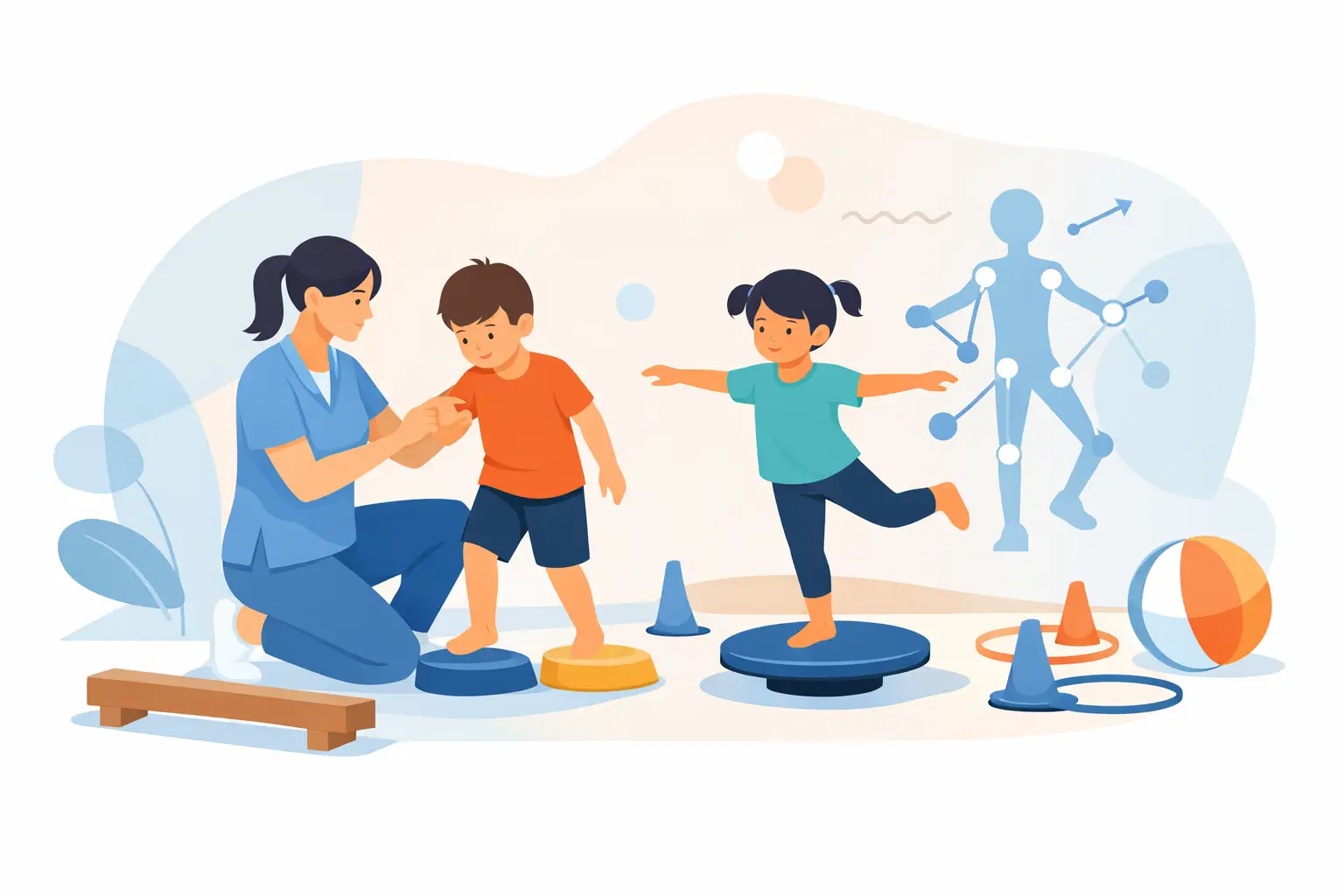
Children learn best when therapy feels achievable and engaging. Pediatric physiotherapy often uses games and movement-based activities to build skills without turning every session into a test.
A therapist may use obstacle courses to practice balance, agility, and motor planning. Ball games can support hand-eye coordination, reaction time, and bilateral movement. Stepping, jumping, climbing, and single-leg activities can improve lower-body strength and stability. Activities may also be adapted to help a child learn how to grade force, move at an appropriate speed, or navigate busy spaces more safely.
The right challenge level matters. If an activity is too easy, it may not lead to meaningful progress. If it is too difficult, a child can become discouraged or avoid trying. A personalized plan gradually increases complexity while giving the child repeated opportunities to succeed.
Hands-on care may be appropriate in some cases, particularly when joint mobility, pain, posture, or muscle tightness affects movement. However, active practice is usually central to coordination-focused rehabilitation because coordination improves through guided repetition, feedback, and experience.
When Coordination Challenges May Need a Broader Care Team
Physiotherapy is often one valuable part of a child’s support system. Depending on the child’s needs, collaboration with a pediatrician, occupational therapist, speech-language pathologist, teacher, psychologist, or other health professional may be beneficial.
For example, fine-motor challenges involving handwriting, buttons, utensils, or scissors may be best addressed alongside occupational therapy. Difficulties with attention, sensory processing, learning, or communication may also warrant further discussion with the child’s healthcare team. If a child has recently developed coordination problems, weakness, frequent falls, severe headaches, changes in vision, or loss of previously acquired skills, prompt medical evaluation is important.
Some children with ongoing motor coordination concerns may be assessed for developmental coordination disorder, sometimes called DCD. Physiotherapists do not diagnose this condition independently, but they can document functional movement concerns and contribute helpful information to a broader assessment process. A diagnosis is not required to begin addressing a child’s movement goals.
Progress Often Starts With Small, Meaningful Wins
Parents understandably want to know how quickly their child will improve. The answer depends on the child’s age, underlying factors, consistency of practice, and the goals being addressed. Coordination development is rarely a straight line. A child may master a skill in the clinic but need more time to use it confidently at school, during sports, or in a busy playground.
Progress may first show up in quieter ways: less hesitation on stairs, improved willingness to try a new game, fewer falls during play, or less frustration when getting dressed. These changes matter because confidence affects participation. When children feel more capable in their bodies, they are often more willing to practice the activities that help them continue improving.
A therapist may recommend a short home program that fits naturally into family routines. This should be realistic, not another overwhelming task on a parent’s list. Five to ten minutes of purposeful play a few times per week can be more sustainable than a complicated program that is difficult to maintain.
Supporting Your Child Without Adding Pressure
Parents can make a meaningful difference by focusing on effort and participation rather than perfect performance. Try to offer activities that match your child’s current ability while still providing a small challenge. A lower step, a larger ball, more space, or extra time can turn a frustrating task into a successful practice opportunity.
It also helps to avoid comparisons with siblings or classmates. A child who feels embarrassed about movement may withdraw from sports, physical education, or active social play. Encouragement should be specific: notice that they kept trying, balanced longer, or remembered a new step. This reinforces progress they can control.
If your child avoids movement because of pain, frequent falls, fear, or frustration, do not assume they simply need to try harder. A professional assessment can clarify what is getting in the way and provide a practical plan for moving forward.
A Personalized Path Toward Confident Movement
At Panorama Physiotherapy and Chiropractic Clinic, pediatric care is approached with the same attention to individual needs as adult rehabilitation. The focus is on understanding the root contributors to a child’s movement challenges and creating a plan that supports function at home, school, and play.
Coordination skills can improve when children are given the right guidance, appropriate challenges, and room to practice without pressure. If you have concerns about how your child moves or participates in everyday activities, a pediatric physiotherapy assessment can be a reassuring first step toward more confident movement and a fuller experience of childhood.